FREE Report
Coach Mitch’s
Ridiculously Simple System
10 Ways Tax Delinquent Property
Is An Extraordinarily Profitable Way To Invest

TDRE Enhances Pre-Foreclosure Investing Techniques
To Dramatically Increase and Accelerate Your Profits.
TDRE has all the benefits of Pre-Foreclosure Investing
that we admire and covet…but is faster, cheaper, and with less stress.
> Little cash / credit needed - $1 to $1000 OK
> No bankers, lawyers or RE Agents involved
> Most deals at $ .25 cents on the dollar or less
• Most REO’s are at 80% of market value
This is NOT Pre-Mortgage Foreclosure
This IS Pre-Pre-Pre Tax Foreclosure
FormProcessor Demo

June 6, 2009

TLC's down - Tax appeals UP. Post 130

Tax delinquent real estate, tax liens, and tax deeds are a great way to invest in real estate. Pre-foreclosure and foreclosure investing is significantly enhanced by Coach Mitch's system.

Miami Today week of May 28, 2009

Dade tax collector advertising fewer properties this year even with recession

By Risa Polansky
Despite a rough economy, fewer delinquent property tax certificates are being advertised for sale in Miami-Dade this year than last.
In 2008, the county tax collector advertised 89,795 properties before the annual delinquent tax certificate sale.
This year, the office is advertising 85,318 properties.
Former local appraiser Tom Dixon said he had expected a jump this year in light of the economy… though he quickly identified a contributing factor.
"The reason is that if there is a tax appeal pending and unresolved, the tax collector does not sell the tax certificate," said Mr. Dixon.
Miami-Dade Property Appraiser Pedro J. Garcia said this month that in the past year, the county has seen 70,000 appeals on about 100,000 properties, up from 40,000 to 45,000 the year before.

Another potential contributor: because of foreclosure, there's a high number of bank-owned properties in Miami-Dade now — and banks tend to pay property taxes.
In 2007, 26,391 foreclosures were filed, more than doubling to 56,656 in 2008.
Through April of this year, 25,577 have been filed, according to county clerk counts.
Alex Sanchez, president and CEO of the Florida Bankers Association, said it's "unheard of" that a bank not pay property taxes once foreclosure proceedings become final and the bank holds the property's title.
"That's their collateral — they want to protect it," he said.
Mr. Gomez of the tax collector's office acknowledged the same.
"Generally, banks would act to protect their interests," he said.

He noted that this year he's seeing more individuals register for the auction.
Hedge funds and institutional buyers have been common in recent years, he said.
Now, "I think we might actually see a return to the auction of these smaller investors" Mr. Dixon said he expects fewer buyers in the game this year and predicted "buyers are going to probably be more competitive in terms of wanting higher rates — but nobody knows until the auction opens."

See entire article at:  http://www.miamitodaynews.com/news/090528/story7.shtml

**************************************************************************************************

Coach Mitch’s REFLECTIONS

People are fighting

In this era of higher property taxes and lowered real estate values, people are fighting harder to keep their property. People are fighting harder today because they feel that they are being taken advantage of.

The property value has gone down, but often the assessor has not reduced the properties tax assessment. To be fair, it is not possible to do a system wide appraisal and adjust the assessments each time the market reacts to a different condition.

Taxpayer logic

However, people see that their value is down, dramatically down in some places, and they figure that their property taxes should also be reduced. People feel this way because the taxes are based on the property assessment or value. Therefore, if the value of the property has down, it stands to reason that the assessment should go down and the taxes along with it.

Tax Rates are adjusted

The system has a built in adjustment – the tax rate. This is the mechanism used to adjust each taxpayer’s yearly taxes.

The taxing jurisdiction determines its total monetary need, divides this amount by the value of the property tax base and this results in a tax rate. The tax rate is spoken of as a tax rate per thousand. An individual’s property tax is determined by taking the properties tax assessed value and multiplying it by the tax rate.

Example

If the tax rate is $20 per thousand dollars of assessed value, then multiply $20 by the number of thousands of property value. Take a $100000 home, the calculation would be $20 times 100 or $2000 in property tax.

In some areas the tax rate is spoken of as a rate per hundred. Everything is the same except that all calculations are done to be shown in hundreds not thousands. The $100000 home would be calculated by taking $2 per hundred dollars of assessed value (not $20 per1000) and then multiplying by the number of 100’s in 100000 or 1000 equaling $2000 in property taxes.

Other factors

The town still needs to pay its bills, no matter the condition of the market. If market conditions reduced the value of the property by 50% and the tax assessments were also lowered by 50% and the tax rate were to stay the same, then the town would only raise 50% of the revenue it needs.

Example

In this example, the assessed value is $50000 and the tax rate is $20 per thousand. The familiar calculation is 50 x $20 equaling only $1000 in property taxes.

Taking this example, the tax rate would need to be doubled in order to raise the same amount of capital. If the property is now worth only $50000 and is tax assessed at $50000, then the tax rate needs to be $40 per thousand - $40 per thousand of assessed value times 50 gives us the same $2000 in property taxes.

Nickel and diming

So as not to bring so much attention to higher property taxes, a town board will raise monies by increasing other fees. Therefore, taking your kids to the town pool will cost more, or registering your softball team if using the town’s ball field will cost more, or registering your dog to go to the town’s dog park will cost more.

Assessors do adjust assessments

The tax assessor does adjust, but it is with an ax versus a scalpel. The assessor will look at neighborhoods, determine how much of an adjustment is relevant, and adjust the assessments for that neighborhood.

Example

Imagine that MLS sales figures show that the town has gone down 20% in overall value but the 10 different neighborhoods have gone down at different rates and one neighborhood held its value. Within each neighborhood, types of houses have fared differently. Sale prices for 3500 sf homes dropped significantly, while 2000 sf homes dropped moderately and 1300 – 1500 sf homes held steady or rose slightly. The assessment adjustments should reflect these realities. As you can see, there is science here but there is also a lot of art.

Taxpayer’s have a case

Because the tax assessments and any adjustments are not precise, a taxpayer can feel that their property is over assessed and is being asked to pay too much tax.

Appeal

Each state has a process allowing taxpayers to appeal their property taxes. It can be a daunting process, however it is worth pursuing.

The article above shows that these good folks in Dade County are appealing their property taxes at a much higher rate than before. Good for them.

Until next time,

Mitchell Goldstein Coach Mitch

518-439-6100

Filed under Tax Delinquent Real Estate by

Permalink Print Comment

May 28, 2009

Predictions - Investors back off tax liens. Post 129

Tax delinquent real estate, tax liens, and tax deeds are a great way to invest in real estate. Pre-foreclosure and foreclosure investing is significantly enhanced by Coach Mitch's system.

St Petersburg Times Florida

Tax lien auction still leaves $2.6 million gap for Pasco

By Jodie Tillman, Times Staff Writer
In Print: Thursday, May 21, 2009

It may have been a record, but it wasn't the one that Pasco Tax Collector Mike Olson was hoping to set: More than $2.6 million in property taxes for 2008 remains unpaid after Tuesday's tax certificate auction.

"It's probably record-setting," Olson said of the figure. "And that's because of the economy."

Investors, who pay the outstanding taxes in exchange for liens on the properties, participated in smaller numbers and seemed worried about tying themselves to properties that they'd never see a return on, said Olson.

In better financial times, more bidders jumped in for the tax certificates, especially after the auctions were moved online. That meant more competition, driving down the interest rates. It was good news for delinquent property owners who intended to make good on their bills: They didn't have to pay as much in interest.

In the 2007 auction, for instance, the average winning bid was an interest rate of 1.72 percent, said Olson. (Investors are actually guaranteed a minimum of 5 percent, he said, but they offer lower interest rates as a bidding strategy.)

By 2008, that average rate had jumped to 8.3 percent.

And this year? 11.3 percent.

In 2007, only 66 certificates were sold at 18 percent interest, the maximum rate that suggests the highest risk. Last year there were 328. This year? 678.

Olson said he has yet to analyze whether certain properties were more or less popular than others among bidders. But investors have an even more difficult time navigating the risks these days.

Buy a certificate on a property whose owner ends up in bankruptcy, he said, "and that beautiful 12.5 percent rate you got will be thrown out by the bankruptcy court."

Properties with homestead exemptions had been considered safe, he said, because homeowners typically want to pay those taxes off fairly soon — but that's "in normal times."

"I held mine [auction] extremely early this year because of my concern of whether there'd be sufficient investor money this year in the state of Florida to cover 67 counties," he said.

See entire article: http://www.tampabay.com/news/localgovernment/article1002847.ece

************************************************************************************

Coach Mitch’s REFLECTIONS

Some TLC’s are in trouble

Tax lien certificates have always been a checkered investment; with some parts good and some parts not as good.

For instance, just a short time ago, the Maracopa County, AZ tax lien sale sold out. Every TLC was sold, including TLC’s against lots far out in the desert, without utilities, nor the prospect of getting utilities in our lifetime. Numbers of TLC’s were sold that are worthless. However, the county needs money and some people naively trust government to do the “right” thing – like sell something only if it has value.

Now, in this economy, in certain areas, we are starting to see the marketplace at work. The great part about the “invisible hand,” as Adam Smith called the free market, is that the market can often be predicted.

Prediction 1

The market prices of property in hard hit areas like Florida will stay down for several years. I have been told that we could see a decade of lowered real estate prices. I hope this estimate is overblown.

Prediction 2

Speculative TLC purchases will be reduced significantly. Private monies will continue to buy most of the TLC’s that are out there, however, there is waning desire to buy TLC’s that are not high quality; in the same way that currently, investors are trying to trade in quality stocks and bonds.

Prediction 3

TLC Investors and tax deed investors are being much more conservative, more careful and implementing strategies that protect themselves rather than waiting for a market change or letting people work out a problem.

This change in attitude will mean that there will be heightened competition for the best tax delinquent properties, but that the other, less desirable properties are going to have less competition. The result will be that TLC investor’s will drop out of the bidding earlier, that they will require a higher interest rate of return and that the TLC holder will be going after deeds more aggressively.

Prediction 4

You would be amazed at the number of TLC holders who automatically buy the same TLC year after year against the same property. These are mostly purchasers for estates.

I predict that beneficiaries will take a hard look at their TLC assets and perhaps decide to foreclose the TLC rather than wait for a redemption or at least to more closely watch their portfolio. There may even be a spate of lawsuits against trustees and executors of estates who are not performing their due diligence well enough.

The issue is that the property may not be worth the accumulated TLC investment, especially in a lengthy down market.

Prediction 5

For the savvy TLC investor, there will develop a new way to enter into the TLC investing market. You have always been able to offer to buy the TLC asset portfolio of TLC holders, and at a substantial discount. Whereas previously TLC holders would refuse to sell, today they will accept. The times they are a chang-en.

Most TLC investors have the mindset to just buy the TLC’s, let them accrue with high interest, and wait for the redemption.

Little known is that TLC’s become invalid after a certain period. This rule is in many TLC states. In Florida, the law stipulates that an unredeemed tax lien becomes invalid after seven years. I have seen numerous investors continue to buy the newest TLC against a property even after the oldest TLC has become invalid, because it is older than seven years.

These folks are foreclosure adverse. They do not want to foreclose, that is too much work; they are arm chair investors. Yet, they do not want to lose their investment. If you were to offer to buy their TLC’s on a particular property, they might sell. If the interest had been accumulating at 18%, the resulting total might be more than the value of the property. The investor might be interested in getting their principle back and either foregoing the interest or significantly reducing the interest – just to get to cash.

This would be a great way to utilize Coach Mitch’s famous $1 Option Series strategy. Every one of Florida’s 67 counties has many such investors with large portfolios who may want to get to cash. Just investigate and offer to pay them – after you have sold the property.

Prediction 6

Self Directed IRA’s will explode in numbers and in value.

After the average American has been exposed to the enormous value that an SDIRA can bring to their investing mindset – they will embrace the SDIRA as never before.

Imagine having a Roth SDIRA. Using Coach Mitch’s famous $1 Option Series strategy, (you) your IRA options a property with $1, the IRA sells the property for a $20000 profit and the IRA retains the profits – tax free. It would not take very long for the depleted SEP, 401K, or IRA to again wallow in gains.

Prediction 7

Big government, in collusion with big business, has created this mess and they are certainly not going to do anything to diminish their power and reach in the cleanup. If anything, we are seeing a concerted effort by big government exerting ever more control over the economy.

Big business is pushing this process along by demanding and getting what they want. The biggest of the players know that they will be protected and given privileges. For instance, the banks used their bailout monies to buy up more assets versus lending to keep companies functioning and payrolls active.

Prediction 8

Taxes, fees, bureaucracy, and autocracy are going up – way up. And, quality of life will continue to go down.

Prediction 9

Passions will be rising on all sides, partly headline driven, for profits, but mostly driven by frustration with the system.

Curbs on civil rights will continue under O, but taking on a distinct liberal agenda. Tenant advocates vs. property rights, the poor vs. the middle class, and the rich vs. everyone else. Populism will be on the rise, driving anger, with patience almost at an end.

Private property will continue to be assaulted, gun control will be pursued aggressively. The plight of the poor and undocumented will be foisted onto the struggling middle class in the name of “fairness.”

The idea that taxes are “legalized theft” will start to take hold. More and more of the “Silent Majority” will begin to speak out but wanting opposites; less taxation and government intrusion while demanding costly government unemployment benefits, medical aid, and job security. The call for trade sanctions and barriers will rise.

Prediction 10

In some ways O is not acting as the liberal, with no change from Bush policies; continuing the lack of Habeas Corpus and the Bush strategy in the Gitmo trials. People will start wondering: Either O did not understand the terror threat prior to election, OR O did understand and he lied – in order to be elected. Either way, O loses and his credibility is lessened.

Go Great Guns,

Mitchell Goldstein Coach Mitch

518-439-6100

Filed under Tax Delinquent Real Estate by

Permalink Print Comment

May 27, 2009

Florida tax liens - Beware! Post 128

BARTOW | Friday is the last day to pay 2008 property taxes without incurring extra costs, according to Polk County Tax Collector Joe G. Tedder.

After June 1, tax certificates on the delinquent tax bills will go on sale, Tedder said.

Tax certificates are sold to aid local governments in recouping the tax money already budgeted but not yet received.

Tax certificates are liens that property owners must pay to settle their tax bills.

Investors can bid to receive interest rates of up to 18 percent, but the lowest interest rate wins the bid, according to state law.

Tedder said any investor who purchases a tax deed and holds it for at least two years from the date the taxes were due can apply for a tax deed, which will result in the sale of the property.

According to the latest figures, investors have bid on only 12,456 of the 36,847 tax certificates that are being sold this year.

As of last week, there were $56 million in unpaid property taxes.

Last year when the delinquent taxes that are advertised annually the total was $38 million.

Tedder said he expected to hold a second round of bids this year, too.

In the second round, investors will receive 18 percent in interest on any of the tax certificates, which could spur more bidding if there are still attractive properties on the list, Tedder said.

He explained there is some risk in investing in tax certificates, the same as with any other investments.

'It's definitely buyer beware," he said.

Tedder advised anyone interested in bidding to read the information on the Polk County Tax Collector's Web site www.polktaxes.com first.

He said people can look at the list of properties available on the Web site without registering.

Registration is required only if you want to place a bid.

See entire article: http://www.theledger.com/article/20090522/NEWS/905239987/1338?Title=Pay-Property-Taxes-by-Friday-or-You-Pay-More

***********************************************************************************************

Coach Mitch's  REFLECTIONS

Buyer Beware!

The great state of Florida is a wonderful place to get tax lien certificates. Unfortunately, currently, it is not as great as it used to be. Therefore, your best course of action is to be very careful before purchasing a Florida TLC.

Hurricanes

What do hurricanes have to do with a decision to invest in tax liens?

We all know that the brass ring in TLC investing occurs when you pay the delinquent property taxes and when the property owner does not redeem, and then you get the property itself - for the cost of the taxes.

The insurance companies offering hurricane insurance have increased their rates significantly. In fact, hurricane insurance is very, very expensive. I have heard of situations where people are paying $1500 for their property taxes, but are now paying $6000 for hurricane insurance.

Make sure you want the property

People do not pay their property taxes when there is some trouble or issue in their lives. Almost all folks resolve their situation enough to gather sufficient funds to pay the taxes, but sometimes they don’t.

In Florida, the system requires the TLC holder to hold an auction. The minimum bid is the taxes and costs due. The TLC holder is an auction bidder, just like everyone else. The opening bid is the amount of the outstanding taxes plus costs. If anyone bids, the TLC holder is required to bid higher, should he want the property. Any bid over the amount due is considered “excess proceeds” and is due the delinquent property owner or other parties who are due monies.

Know your values

I have heard many stories about the great deals that were had at these tax delinquent property auctions. However, the most important issue always is, make sure of your property values, and make sure you can execute your exit strategy.

Happy investing,

Mitchell Goldstein – Coach Mitch

518-439-6100 until midnight EST

Filed under Tax Delinquent Real Estate by

Permalink Print Comment

May 18, 2009

The Government VS Joe Kaiser. Post 127

Tax delinquent real estate, tax liens, and tax deeds are a great way to invest in real estate. Pre-foreclosure and foreclosure investing is significantly enhanced by Coach Mitch's system.

seattlepi.com

Thursday, May 7, 2009
Last updated 6:19 p.m. PT

Foreclosure guru hit with $3.2 million penalty

"I'm the Tiger Woods of foreclosure rescue" accused man claims

By LEVI PULKKINEN
SEATTLEPI.COM STAFF

To state lawyers, Joseph Kaiser is a swindler, preying on homeowners facing tax foreclosure who don't know their options.

To one King County judge, he's a purveyor dealing in "grossly unfair" rescue schemes. To another judge, he's a debtor owning his hundreds of former clients millions of dollars.

But to Kaiser, he's the victim of a state "witch hunt" demonized for trying to help homeowners.

"I'm the Tiger Woods of foreclosure rescue — I'm really good at this," Kaiser said Thursday. "In reality, no one has ever been harmed by anything we've done."

Attorney's with the state Attorney General's Office disagree, as has King County Superior Court Judge Palmer Robinson, who on Wednesday ordered that the Tacoma man repay $3.2 million in restitution and penalties.

Attorneys with the state agency assert that Kaiser, creator of Fiscal Dynamics, Inc., Cumulative, LLC, and other companies, used his background as a real estate investor to scam unsophisticated homeowners into transferring ownership of their properties to him as part of a fake foreclosure-rescue scheme.

"I don't want to be bothered with anything less than a real steal deal," Kaiser said in his teaching materials, the state alleged.

Though direct mail and telemarketing, Kaiser contacting homeowners in danger of tax foreclosure, State attorneys contend.

In some cases, he would then offer to "rescue" their home through an arrangement in which one of Kaiser's companies would become the owner of the property, Assistant Attorney General Jim Sugarman said. Former owners would then essentially become renters in their own homes, paying rent to Kaiser until he could force the tenant out.

Sugarman said that in other cases, Kaiser would offer false incentives to owners in danger of losing their homes in order to get them to sign away any excess money that was made when the home was sold at auction.

Sugarman said that Kaiser tricked homeowners into signing legal agreements that passed that excess money to him.

"One of the most galling things about this is a lot of these people were either elderly or disabled or low income and there are tons of programs out there for people who are elderly, disabled or low income," Sugarman said.

Kaiser entered transactions with more than 300 property owners, an Attorney General's Office spokeswoman said in a statement. None, the Attorney General's Office claims, successfully regained their home from Kaiser.

Speaking to SeattlePI.com, Kaiser portrayed himself as a do-gooder who happened to be making a profit. He denied every allegation of wrongdoing, contending instead that the Attorney General's Office was out to get him because county government could otherwise collect the excess payments if the former homeowner didn't come forward.

"It's just so bizarre to be involved in this and to hear what comes out of their mouths," Kaiser said. "What has essentially happened is that the Attorney General's office has determined that people in foreclosure cannot be helped.

"These people have problems. They have situations. And they appreciate that they have someone to put out fires for them."

Kaiser's arguments, though, have failed to persuade two King County judges in separate actions

Superior Court Judge Michael Trickey called Kaiser's contracts "grossly unfair."

"No fully informed person, not acting under compulsion, would enter a transaction with such onerous terms," Trickey said in a ruling.

Late Wednesday, King County Superior Court Judge Palmer Robinson signed a restitution order requiring that Kaiser repay $3.2 million in restitution to his former clients as well as additional penalties and fees to the state. Including settlements reached by other defendants in the case, a total of $4.2 million in fines and restitution has been assessed against Kaiser and his associates.

Robinson ordered that Kaiser repay the full $3.2 million assessed against him within 30 days. He (Joe Kaiser) said he's considering his appeal options, but is essentially bankrupt and unable to continue to defend himself.

See the entire article: http://www.seattlepi.com/local/405975_foreclosure07.html

**************************************************************************************************

Coach Mitch’s REFLECTIONS

Don’t let truth stand in the way of a conviction

I don’t know most of the story about the case against Joe Kaiser, but I do know about some of the motivations of the government.

The sad truth is that government, at all levels, is not ashamed to grab monies from any source and in any amount. Government is under great pressure to find new sources of revenue and squeeze out any monies that it can. And they are serious.

The government is very protective of its money pipelines. Tax monies are the lifeblood of government. Without sufficient monies, some of the empire building may have to slow down or stop altogether.

“Get your hands off my money!”

Joe Kaiser is guilty of intruding onto what is quickly becoming a government turf - the tax auction over bids.

The law allows a property to be taken because the owner has not paid its property taxes. At a tax sale auction, the property may fetch a good amount, as property prices have climbed significantly, especially during the last eight years.

Any amount bid over the taxes owed is called an over bid. These monies are rightly the former owners. They owed the taxes, the property was the collateral; the collateral was sold and brought in more than the taxes that were owed. The previous owner has lost his property; he should at least get the excess proceeds of the sale. For the government to take the excess proceeds is “unseemly” according to a federal judge in a Vermont case. But, it seems that fairness is not part of the government’s standards.

The overage is what this trial is all about

The states and counties, in the last ten years, have maneuvered the law and created procedures so that the government can now claim the overages and legally steal them from the previous owner. There is a lot of money at stake and the governments want it.

Joe Kaiser was a thorn because he was getting the overages and the government saw this as a slap in their face and a deliberate attempt to take “their money.” The attorneys were told to stop the leakage, and they did, no matter the cost.

Joe’s tale

Go to Joe Kaiser’s blog, http://www.pushedtoshove.com/ and read his side of the story.

Joe claims to have done 400 transactions, the state says 300. Joe claims that 30 families he helped are still in their homes, the state says Joe helped none.

The state says that Joe took advantage of people, committing fraud, yet none of Joe’s clients has ever filed a complaint, even after they lost their property.

Judge Trickey, in his ruling, says that "No fully informed person, not acting under compulsion, would enter a transaction with such onerous terms." That may be accurate - but it is not up to the state to overturn a contract, freely entered into. The judge is saying that no agreement can be made unless all parties are fully informed and that no one is under stress.

Well, pardon me, but we all know that this is not a standard that can be achieved in the real world, nor should it be. For one, do we go to court on each deal so that Judge Trickey can determine what it means to be “fully informed?” Free people are free to make any kind of deal they want or feel that they need too; even a bad deal.

To relieve the stress, so that there is no longer any compulsion, the judge should eliminate the power of the state to tax property! That is a more logical solution than the cock-a-mamie logic of this judge.

The state was angry that old folks and cripples were put out on the street because they could not pay their property taxes. Well, there is a very easy fix; government should spend less, tax less, and eliminate the entire property tax taking system.

Additionally, the state should fully inform harried taxpayers about any programs that can help their situation. To not do so seems negligent, perhaps even criminally negligent, because it is easy to see that it is in the state’s interest to NOT inform the harried taxpayer about any help that may be available.

The state claimed that Joe took advantage of people when they were vulnerable. The state has no problem taking the home away from these people and kicking these same people out onto the street. The state even passes laws that make it so that no one can help these people in their dire need; and all the while the state beats its chest proudly and says that it is doing good by protecting citizens from hucksters. The state does all this just to get its hands on the over bid monies.

What a racket

The state went after Joe because he took advantage of his specialized knowledge and offered people under stress, an alternative. Four hundred of Joe’s clients thought that he had created a “win-win” situation. I thought that’s what we are supposed to do in these United States?

I wish you well Joe -

Mitchell Goldstein Coach Mitch

518-439-6100 until midnight EST

Filed under Tax Delinquent Real Estate by

Permalink Print Comment

May 9, 2009

Landlording 202. Post 126

Tax delinquent real estate, tax liens, and tax deeds are a great way to invest in real estate. Pre-foreclosure and foreclosure investing is significantly enhanced by Coach Mitch's system.

Coach Mitch’s REFLECTIONS

Landlording

If you are going to be part of the real estate investing business, understand that you will be a landlord at some point.

Get over it

I know, I know. No one wants to be a landlord. Well, I’m sorry, but it comes with the real estate investing territory.

It might not hurt much

Imagine if you are looking at a house that you believe is a good deal and the property has a tenant with a lease. Do you turn that deal down and walk away just because there is a tenant to deal with? Maybe you do. But then again, maybe you think it through a bit more thoroughly.

Why should you be a landlord?

For the money, honey!

There are times when the money from a rental is just too good to pass up. I don’t even consider a property with less than $200 per month clean profit, that is, after ALL expenses are paid. I don’t puff up the return by counting in depreciation. I currently don’t have a unit with less than $350 per month net profit. That’s not bad. You don’t need too many rentals to have a comfortable cushion with that level of margin.

What about the horror stories!

I have had my share of bad tenants. However, there are ways to mitigate your negative potential.

Rules to follow:

1 Always get a complete tenant record. This will include all of a tenant’s information, including how to contact relatives or friends, license plate numbers, driver’s license, several credit cards, etc. When a tenant skips, you want to be able to trace them.

I learned this from the owner of a Buy Here, Pay Here auto dealership. She would know where the car owner went to drink, who the friends were and who all the family members were and all their contact information, etc.

When the car owner missed a weekly payment, this dealer would be on the phone, tracking down the car so that she could send the tow truck and pick it up. She knew where the car was because she had asked where the owner was drinking. Then she could probably get her payment, because the owner needed the car, but she was in possession of the car, which she could legally take, then resell, and recoup any loss via judgment. Her record was taking and reselling the same car nine times.

2 Always call the previous landlord, not only the just past landlord. The previous landlord will tell you the truth about this prospective tenant. Be sure that you are speaking with the previous landlord and not just a friend of the prospective tenant who is playing that role. Prior to calling the previous landlord, check the deed records to find the owner’s name at the property address. More and more, you can do this online or you can call your county recorder and ask that they look up who owns the property at 123 Broadway. Then, ask the previous landlord to verify something, like the date they got the property or the seller, etc.

3 Get a hefty security deposit. I now get three months. I get the first month’s rent, plus two months security. Costs to repair are very high these days. By asking for higher security, you ferret out those who do not save.

4 Document the property as a tenant moves in. You should be taking pictures and/or movies, with dates to show the condition of the property upon move in. Record the make, model number, and serial numbers of all appliances. Record all fixes and all communications with tenants. Record all damage with a picture and a follow up letter. Always communicate in writing. Your lawyer will love you and the judge will believe you.

5 Be a good landlord. I was involved in my REIA, Real Estate Investors Association, for over ten years, mostly on the Board of Directors or as President. I heard lots of stories, about bad tenants, and about bad landlords. Guess what, sometimes I had to side with the tenant. Often landlords are so cheap that they hurt themselves.

I always put this into my ads: “Good landlord seeks responsible tenant.” You will get about 50% - 66% fewer calls because the bad tenants will screen themselves out.

I am very careful about charging fees. Though allowed, I will often not charge a fee, however, I will charge if I feel that I am being taken advantage of. I will let the tenant know my reasoning for not charging the fee. They are always grateful for not being hit with another $50 fee. You build up some good will by being generous. Document that you let the fee pass because a judge could rule that, once not charged, you have given up the ability to charge.

6 Only rent to those who will not leave their job if they owe you money? By only renting to persons who work for government or to those who are in a serious career, you greatly raise you potential of getting your rent paid or getting paid on a judgment.

7 Become comfortable with confrontation. If a tenant is not performing well, then write a letter and inform them of your thoughts. Threaten to evict but put the tenant on probation. Know the procedures for eviction and for going to small claims court and to superior court in each area that you own property. Know the procedures for collecting on a judgment.

8 Pursue judgments. You will be surprised that the process is manageable, though a bit cumbersome. It is great to get a series of checks each month, to pay off a wage garnishment.

As soon as you know that a tenant is leaving, schedule a walkthrough and document what needs to be done to bring the property up to a good condition. Document everything. Don’t be shy about this. With the costs of everything these days, you need to mitigate any losses.

The military will help you track down any soldier, anywhere in the world, and they will help you with your garnishment. Especially today, those in government and in education are thankful for job security. Most professionals do not want their reputations tarnished by judgments so they are less likely to skip.

9 Don’t be in a hurry to get a tenant. Be choosey! The higher the quality of the tenant, the less likely you are to have negative issues and if you do, the more likely it will be that you can collect on a judgment. Getting your money is the prime concern.

10 Include lease clauses that protect your interests. I have tenants pay for the first $500 of all repairs, excepting major systems. I have the ability to break the lease and sell the property without any penalty. I don’t include appliances with the rental. Rather, I rent the appliances to the tenant, so that if they break, I might force the tenant to buy their own appliances. I require a two year tenancy, with built in rental increases. For an extra fee, I include a “Non-option option.” This is a right of first refusal to purchase, should I desire to sell. I seek being paid via automatic electronic bank transfer. If a tenant falls behind, I have them pay weekly. Allow for an exception in stated policy without you losing the ability to implement that policy in the future.

Landlording can be manageable and profitable.

Good luck,

Mitchell Goldstein Coach Mitch

518-439-6100 until midnight EST

Filed under Real Estate Investing by

Permalink Print Comment

May 8, 2009

Commercial Paper may be the next shoe to drop. Post 125

Tax delinquent real estate, tax liens, and tax deeds are a great way to invest in real estate. Pre-foreclosure and foreclosure investing is significantly enhanced by Coach Mitch's system.

Coach Mitch’s REFLECTIONS

I will let this email speak for itself.

Commercial Paper time bomb

Subject:  The One Trillion Commercial Real Estate Time Bomb

From: cfo-newsletter@emailblitz.com

Date: Mon, May 4, 2009 8:37 am

To:

————————————————————————–

The One Trillion Commercial Real Estate Time Bomb By: Zero Hedge

data provided by Deutsche Bank Â

The unprecedented economic deterioration resulting in a drop in commercial real estate values (the core of the problem is the decline in prices of the underlying properties, in many cases as much as 35-50%) could result in over $1 trillion in upcoming headaches for financial institutions, investors and the administration.

The CMBS (or securitized conduit financings) is at most 25% of the total commercial real estate market, with the bulk of exposure concentrated at banks (50%) and insurance companies' (10%) balance sheets. But regardless what the source of the original credit exposure, whether securitized or whole loans. The refinancing problem is the altogether entire current shut down in debt capital markets for assets, which affects all refinancings equally (for the most immediate impact of this issue see General Growth Properties which was not able to obtain any refinancing on the bulk of its properties). The government is addressing this first theme through all the recently adopted programs that are meant to facilitate general credit flow. Note the skepticism that these are working in any fashion, especially with regards to lower quality assets. The second and the much more serious and less easily resolved issue of the negative equity deficiency on a per loan basis, which is not a systemic credit freeze problem, but an underwater investment problem.

The reason for this focus is that there seems to be a misunderstanding in the market that lenders will simply agree to roll the maturities on non-qualifying loans, and that the expected percentage of loans that need special lender treatment is low, roughly 5-10% of total loans. In reality the percentage of underwater loans at maturity is likely to be in the 60-70% range, meaning that refi extensions could not possibly occur without the incurrence of major losses for lenders. To demonstrate the seriousness of the problem it is important to first present the magnitude of the refinancing problem. There are approximately $685 billion of commercial mortgages in CMBS maturing between now and 2018, split between $640 billion in fixed-rate and $45 billion in floating rate. The biggest CMBS refi threat occurs in the 2010-2013 period when 2005-2007 loans mature. These loans, originated at the top of the market, which have experienced 40-50% declines in underlying collateral values, and the majority will have material negative equity at maturity (if they don't in fact default long before their scheduled maturity). Of these loans, only a small percentage will qualify for refinancing at maturity. Cynical readers may say: well even if all CMBS loans are unable to be rolled, it is at most $700 billion in incremental defaults. Is that a big deal. Well, the truth is that CMBS is only the proverbial tip of the $3.4 trillion CRE iceberg. To get a true sense for the problem's magnitude one has to consider the banks and life insurance companies, which have approximately $1.7 trillion and roughly $300 billion in commercial loan exposure. Banks have $1.1 trillion in core commercial real estate loans on their books according to the FDIC, another $590 billion in construction loans, $205 billion in multifamily loans and $63 billion in farm loans.

The precise maturity schedule for these loans is not definitive, however bank loans tend to have short-term durations, and the assumption is that all will mature by 2013, exhibiting moderate increases in maturities due to activity pick up over the last 2-3 years. Adding the life insurance company estimate of $222 billion in direct loans maturing through 2018 per the Mortgage Bankers Association, increases annual maturities by another $15-25 billion. In summation, the total maturities by 2018 are just under $2 trillion, with $1.4 trillion maturing through 2013. And the bad news continues: there is a risk that commercial mortgages will under-perform CMBS loans, and delinquency rates for bank commercial mortgages will be magnitudes higher than those for comparable CMBS. Reflecting on this data should demonstrate why the administration is in such full-throttle mode to not only reincarnate credit markets at all costs (equity market aberrations be damned) but to boost credit to prior peak levels, explaining the facility in providing taxpayer leverage to private investors who would buy these loans ahead of, and at maturity.

Absent an onslaught of new capital, there is simply nowhere that new financing for commercial real estate would come from. An attempt to estimate the number of loans that would not conform for refinancing, based on two key criteria of cash flow and collateral presents the conclusion that roughly 68% of the loans maturing in 2009 and thereafter would not qualify. The amount of refinanceable loans is important because borrowers will either be unwilling or unable to put additional equity into these properties. For the purposes of the refi qualification analysis, the criteria that have to be met by an existing loan include a maximum LTV of 70 (higher than current maxima around 60-65), and a 1.3x Debt To Service Coverage Ratio (equivalent to a 10 year fixed rate loan with a 25 year amortization schedule and an 8% mortgage rate). The simple observation is that nearly 68% of loans in the next 4 years will not qualify for a refinancing at maturity putting the whole plan to merely delay the day of reckoning indefinitely at risk of massive failure. The underlying premise of maturity extension as a solution to a loan's qualifying problem is that during the extension period the lender is either able to increase the amortization on the loan by some means (i.e. increasing the interest rate and using the extra cash flow to accelerate the loan's pay down), or achieve value growth sufficient to allow the loan to qualify by the end of the extension period. As the equity deficiency for many loans is far too large to be tackled by accelerating the amortization over any period of time, and as for "value growth", with hundreds of billions in distressed mortgage building up over time via these same extensions (even if successful), the likelihood of property price appreciation is laughable:

the flood of excess supply of distressed mortgage to hit the market is about to be unleashed. Then there is the logical aspect: maturity extensions merely delay the resolution and push the problem down the road.

And as for CMBS, the issue of (loan) extension may be dead on arrival - not only are CMBS special servicers limited to granting at most two to four year maturity extensions, but AAA investors are already mobilizing to stanch any more widespread extensions as a means of dealing with the refi problem. And, at last, there is the view that the refi- problem could fix itself, based on the argument that CRE cash flows are likely to rebound quickly as the economy begins to improve due to pent-up demand. This argument is nonsense: even if cash flows recover to their peak 2007 levels, values would still be down 30% as a result of the shift in financing terms. Ironically, it would require cash flows rebounding far beyond their peak levels to push values up sufficiently to overcome the steep declines. This is equivalent to predicting (as the administration is implicity doing) that the market will be saved by the next rent and real estate bubble, which the U.S. government is currently attempting to generate.

Filed under Tax Delinquent Real Estate by

Permalink Print Comment

May 4, 2009

Consider selling - NOW! Post 124

Tax delinquent real estate, tax liens, and tax deeds are a great way to invest in real estate. Pre-foreclosure and foreclosure investing is significantly enhanced by Coach Mitch's system.

Coach Mitch’s REFLECTIONS

The Recession Is Over!!

This is the headline coming from the talking heads at CNN, etc. A significant percentage of the nation’s media is very determined to do what it can to bolster President Obama’s agenda. To this end, they trumpet any small piece of good news. If there are several sets of what can be construed as good news, then the thought must be shouted, “The recession is over – hail, hail, hail.”

Don’t you believe it

The recession is being fueled by the housing crises and the foreclosure mess will be with US for quite a while, at least one year more. One guru I spoke with says that real estate prices will be under pressure for the next decade. In his opinion, prices will continue to drop.

Prices are at their high’s – right now!!!

Prices are continuing to spiral downward - all over the country. The few, small pockets where we still see strong growth, are not consequential. The downward pressures on prices are significant.

Prices are going down

In any kind of down market, i.e. a buyer’s market, the buyer will not be seeking to pay the FMV, Fair Market Value; they will be seeking to pay a lower amount. The feeling is that there are plenty of other choices and that a lower price can be gotten.

Just look at the trends

The “Days On Market” are longer, meaning that it takes longer to sell the property and that translates into a pressure to lower the price. It only makes sense, the longer on the market, the more the question is asked, “What is wrong with the property that it hasn’t sold?”

There is greater pressure for the initial asking prices to be lower because realtors realize that they don’t want to waste that precious moment when a property first comes onto the market. If the price seems too high, prospective buyers just ignore the property.

The pool of buyers who are able to get a mortgage is much reduced. This is the greatest danger. The “Mirror Test” no longer applies. Previously, if you could fog a mirror, then you could get a mortgage.

Banks are currently asking buyers to measure up to real banking standards. Buyers must prove income. The NICNAC, No Income Check, No Asset Check mortgages are no longer available. This eliminates buyers who are independent business owners because they consciously reduce their incomes so they do not pay higher income taxes.

Buyers must pay a real and significant down payment, at least in historical terms. Minimally, 5 to10 percent and often 20 percent down payments are being required.

Appraisals are down. Appraisers are under pressure to come in with numbers that are “accurate.” A 10 percent lowering on a $250000 house translates into a lot of money.

Foreclosure rates are strong and staying strong. With more property in foreclosure, the banks are under pressure to get rid of them and this lowers prices dramatically.

Commercial activity is down. Mall stores are closing and there are few new clients in the wings, waiting to expand in a recession.

People are under pressure by government because the government is seeking ways to increase its revenue. IRS is being more adamant. State tax collectors are being more adamant. Government feels that it has its obligations and needs money. If you are a casualty, well, that’s too bad, but there is a government program to help you - if it’s funded.

Private lender funding is UP. The interest rates are also UP. This automatically means that the amount that one can borrow is DOWN. Higher interest means the monthly payments are UP, automatically lowering prices. If a buyer can afford a maximum $1000 per month payment and interest is UP from 4% to 8% - 10%, then the difference has to come from a lowered principle payment which means a lower purchase price.

Tax sales are UP, way UP. Because the real estate market is going down, tax delinquents are increasingly letting property go to tax sale. They may not have the monies to pay the taxes, but the real motivation to give up the property is that the tax delinquent doesn’t believe that they can sell the property for a profit, therefore, why should they continue to pay the taxes?

Speak to buyers or investors and their mentality is like sharks or alligators. They are just swimming around, looking for that bargain which can be swooped down upon.

Consider selling NOW!

All this doom and gloom leads to one conclusion, sell NOW. Prices are at their peak now. Next year, they will be lower. Then how will you feel? You will say, “I should have sold last year.” Take the hit, lower your price and sell. I am. I have considerable equity in my home. I am doing some upgrades, about $10000, and I am putting the property on the market this spring.

Find great deals NOW

I am looking for some land, in a lower tax area, and I will probably build. The land prices are lower and the building costs are reduced. Sometimes there is excess inventory that can be gotten at a good price.

Coach Mitch’s Tax Delinquent Property Ridiculously Simple System

This is the perfect system to find property that can be sold at rock bottom prices. “Rock bottom” is the price that you need to pay, because prices are going down. We don’t know where they will stop and you need to be able to sell. Therefore, if buying property as an investment, you must buy at “rock bottom.”

Be careful, but be profitable.

Mitchell Goldstein Coach Mitch

518-439-6100 until midnight EST

Filed under Tax Delinquent Real Estate by

Permalink Print Comment

April 3, 2009

Signs work wonders. Post 123

Signs work

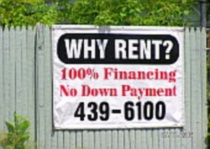
Look in the exterior sidebar.  See the picture of a sign.  It reads: "Why Rent?  100% Financing, No Down Payment, 439-6100." I have used this sign many times. Each time I have a property for sale, I display this sign prominently - and the phone rings. At a minimum, this sign has always generated at least one or two calls a day. The sign has paid for itself many times. It cost me $90, about 7 years ago. It will probably cost about $150 today.

The leads are good

The leads that come from this sign are very good because the prospect is driving by your house. If they are calling, it usually means that they currently live nearby or that they desire to live in the area by your house. The prospect has seen the house and is impressed enough that they have called. If they did not like the house, then the prospect would probably not have called.

Offer a reward on your flyer

I usually pass out flyers in the surrounding neighborhood about the property. I offer a $300 REWARD to anyone who finds me the buyer. If a neighbor drives by, they will see the sign and feel that the property is in play. People often wish that a friend or relative lived nearby. If grandma were to live nearby, this could be their chance to have a reliable babysitter.

They think, “Grandma’s been saying that she wanted to move. It would be great if she could get this house and I could sure that $300 reward! I better call grandma now, before it’s taken.” The neighbor feels that they had better tell their friend or their relative about the home quickly, because they believe the sign will bring a lot of attention.

The sign pays for itself

If you are interested in creating this kind of sign for your business, then look in the Yellow Pages under “Signs.” I had a banner made up with a vinyl backing and with vinyl letters. The banner is 2 ½’ x 5’. Important: Create a hem at the top and at the bottom of the banner. The hem is big enough so a piece of flat molding can be slid into the hem. The wood gives the banner rigidity and keeps it straight. With the molding in the hem, the banner does not flap in the wind. I can screw or tie the banner onto the house or a fence or fasten the banner to stakes in the ground.

FREE 18” x 24” signs

I wrote a few blogs on how you can get FREE signs and utilize them to promote your message.

http://www.coachmitch.com/2007/05/06/get-free-bandit-signs-after-elections-part-1/

http://www.coachmitch.com/2007/05/07/get-free-bandit-signs-after-elections-part-2/

When someone calls, take control of the conversation. My first question is, “On which house did you see the sign?” The prospect usually asks, “You mean that you have more than one house for sale?” “Yes,” I say. “What are you looking for; 3 BR’s or 4?” …

Financing

Prospects always ask about the financing. In fact, the “100% Financing and No Down Payment” is the reason that they called. Especially now, when regular bank financing is so hard to get, it is important that you are able to offer prospects the possibility that you will act as the bank.

Dealing in tax delinquent property allows you to have the potential to find many properties where the owner can give you a very good price. You can afford to act as the bank if you have purchased the property at a very low amount. If you get a very good price then you can offer the property at a good price. If you act as the bank, people will pay a higher price because, often, they cannot get regular bank financing.

You can be the bank, carry the note, and get a nice Monthly Cash Flow. You can also sell the note. I will purchase it. In this way, you can Get Cash Now. You can rent out the property and Cash Out Later when you sell the property. Sweet.

The big idea is to have the tools that will make you profitable. Signs are a tool that makes profits. Coach Mitch’s Ridiculously Simple System should be considered as a tool – and it definitely makes you profits.

Blue skies,

Mitchell Goldstein Coach Mitch

518-439-6100 until midnight EST

Filed under Real Estate Investing by

Permalink Print Comment

March 15, 2009

The 'best' and 'worst' housing markets. Post 122

Forbes

10 Best And 10 Worst U.S. Housing Markets

by Matt Woolsey
Thursday, February 26, 2009provided by

The cities that are showing signs of stabilization and those that continue to unravel.

Blame overbuilding and risky loans, a gambling mentality or even the desert sun, but based on recent results from the S&P/Case-Shiller home price index, which measures metro home prices in 20 cities through December 2008, Las Vegas is the weakest market in the country. Prices are dropping quickly (down 4.81% since last month and 33% in the last year), the pace of decline is accelerating at the third-fastest rate in the nation, and based on lost equity, homeowners are out 65 months of mortgage payments.

All signals that things aren't likely getting better any time soon.

…San Francisco's score of 130.12 means prices are up 30.12% from 2000. It still has the potential for a further fall, given the 31% year-over-year drop.

It's not a good thing for San Diego that prices from November 2008 to December 2008 fell 2.13%, but as prices declined by 2.29% from October to November, and 2.44% from September to October, the speed with which prices are falling is slowing.

That slowing rate of decline, also seen in places such as Denver, Washington, D.C., and Boston, helped rank those cities as some of the stronger markets in the country.

Contrast that with Minneapolis, where prices fell just 0.96% from September to October, but by December, the rate of month-to-month declines had jumped to 4.6%, an unwelcome acceleration.

Next, to rule out places in complete depression, we looked at how many months of equity homeowners have lost. Places like Detroit (-2.98%) and Cleveland (-2.07%) haven't declined as quickly over the last month as Seattle (-3.63%) or Charlotte (-2.55%), but that's because prices in those two Rust Belt cities are so depressed it's difficult for them to fall any further. Detroit and Cleveland homeowners have lost 141 and 92 months of equity, respectively, whereas Seattle and Charlotte prices have only declined for the last 39 and 33 months, respectively.

That means cities like Tampa and Miami, which are notorious for overbuilt new inventory and high numbers of foreclosures, perform better on the index than they ought to, as those two factors are not tracked.

Delinquencies (are) a major problem and a sign that the Valley of the Sun won't be bouncing back any time soon. In Phoenix, seriously delinquent loans–those that haven't been paid in 90 days–have increased from 3.5% to 27.3% for subprime loans since this time in 2005. Adjustable-rate mortgages that are seriously delinquent have gone from less than 1% to 20.2% in the same period.

In Depth: Best U.S. Housing Markets

No one is making a great deal of money in real estate right now, but that doesn't mean all cities are feeling the same amount of pain.

New York, N.Y.

Best, No. 1: New York, N.Y.
Index score: 183.5
Prices were last this low: November 2004
Month-to-month drop: -1.72%
Year-over-year drop: -9.19%
Deceleration rank: No. 9

Best, No. 2: Washington, D.C.

Index score: 176.34
Prices were last this low: April 2004
Month-to-month drop:-2.18%
Year-over-year drop: -19.24%
Deceleration rank: No. 3

Best, No. 3: Charlotte, N.C.
Index score: 122.41
Prices were last this low: April 2006
Month-to-month drop: -2.55
Year-over-year drop: -7.19
Deceleration rank: No. 13

Best, No. 4: Portland, Ore.
Index score: 158.5
Prices were last this low: September 2005
Month-to-month drop: -2.53%
Year-over-year drop: -13.14%
Deceleration rank: No. 11

Best, No. 5: San Diego, Calif.
Index score: 152.16
Prices were last this low: October 2003
Month-to-month drop: -2.13%
Year-over-year drop: -24.84%
Deceleration rank: No. 1

Click here to see the full list of the best U.S. housing markets.

In Depth: Worst U.S. Housing Markets

Worst, No. 1: Las Vegas, Nev.
Index score: 131.4%
Prices were last this low: August 2003
Month-to-month drop: -4.81%
Year-over-year drop: -32.98%
Deceleration rank: No. 18

Worst, No. 2: Phoenix, Ariz.
Index score: 123.93
Prices were last this low: September 2003
Month-to-month drop: -5.06%
Year-over-year drop: -33.96%
Deceleration rank: No. 15

Worst, No. 3: Detroit, Mich.
Index score: 80.93
Prices were last this low: April 1997
Month-to-month drop: -2.98%
Year-over-year drop: -21.66%
Deceleration rank: No. 8

Worst, No. 4: Minneapolis, Minn.
Index score: 127
Prices were last this low: April 2002
Month-to-month drop: -4.6%
Year-over-year drop: -18.45%
Deceleration rank: No. 20

Worst, No. 5: San Francisco, Calif.
Index score: 130.12
Prices were last this low: April 2002
Month-to-month drop: -3.81%
Year-over-year drop: -31.24%
Deceleration rank: No. 2

Click here to see the full list of the Worst U.S. Housing Markets.

See entire article: http://finance.yahoo.com/real-estate/article/106645/10-Best-and-10-Worst-U.S.-Housing-Markets;_ylt=AoYS449VYdOuhb1oVGkMNclO0tIF

**************************************************************************************************

Coach Mitch’s REFLECTIONS

Don’t be put off

Each market is its own little world. A city like Detroit was “up” for a long time, just ask any worker at a car plant during the boom times. There are quite a few cities in the south and west that have good recent history, despite the current hic-cup. Government centers, like state capitals, will be doing better than most other areas because the level of employment is so high and steady.

Gloom may not be doom…for you

In the best of times there are many who suffer some financial disaster and they have limited choices. In the worst of times, there are those who understand that certain markets will provide an advantage and an opportunity.

Your MO

Great economic forces are not in our control. There are big people who make decisions that affect US and we have no input into the BIG picture. If you have recognized this reality, then you must next recognize that your responsibility is to you and yours.

This does not mean that you riot or become a thief. It means that you adjust your MO, Modus Operandi, your Method of Operations, to fit the economic circumstances.

There is always hardship

We are each of US responsible for ourselves and our family. Next, we have a responsibility to our community (tribe). Our greater community, our state, and nation also call upon US for loyalty.

Our duty

We should take part in good works, give charity, and participate civilly. A significant part of my life has been taken up in these efforts. I have always worked in the volunteer sector, I cannot pass a nun with a tambourine without donating, and I am a leader in my local political party. My American Jewish heritage teaches me that to help others is a “good deed.” I have always taken this admonition seriously – as do most of US. That is what makes America great.

We must help

When someone has had a bad turn, when they have lost a job or gotten sick, or even if they have not been responsible, certain things occur. Bills don’t get paid and the situation becomes untenable, to the point that the debtor loses assets.

This is when the property owner doesn’t pay their property taxes.

Recognize the situation

You can help by preparing yourself. You must have the good information and then, you must be able to act on that good information.

Coach Mitch’s Ridiculously Simple System shows how to get the good info and then how to act on it.

When you find a tax delinquent in trouble, because their expectations are so low, they will often ask for or settle for very little. Just say, “Yes.” Let them move on with their lives. You will have gotten a great deal - and done a good deed.

Blue skies,

Mitchell Goldstein Coach Mitch

518-439-6100 until midnight EST

Filed under Tax Delinquent Real Estate by

Permalink Print Comment

March 1, 2009

Obama's housing plan may be a bust. Post 121

Tax delinquent real estate, tax liens, and tax deeds are a great way to invest in real estate. Pre-foreclosure and foreclosure investing is significantly enhanced by Coach Mitch's system.

Freedom Works
Feb 20, 2009 Matt Kibbe

Ten Reasons to Oppose the Obama Housing Bailout

The President, just one day after he signed the trillion dollar stimulus bill, started pushing Americans to support his new borrow and spend policy.  This time it is at least $275 billion to bail out people with mortgage troubles.  Among so many other reasons to tell your U.S. Representative and Senators in Washington to oppose this scheme, the Top 10 are:

1. The Bailout Encourages Bad Behavior

…Obama’s plan will shift incentives …setting a precedent for future housing bailouts that the federal government can never, ever take back.  Government is protecting irresponsible home buyers from risk of foreclosure with this plan—especially with the $200 billion for Fannie Mae and Freddie Mac—that will encourage future risky behavior with the prospect of government help.

2. It Rewards the Wrong People

This plan will force the people who were responsible and worked hard to buy what they could afford to pay for those who did not.  Rewarding irresponsibility by forcing people who pay their taxes and their mortgages to bail out the others is not good policy.

Scott Garrett (R-NJ) comments, “Additionally, it provides no incentives or rewards to those homeowners who have been diligently making their mortgage payments, or to those who recognized their financial constraints and chose to rent a home rather than buy one.”

3. It Will Further Nationalize our Housing Market

The plan will certainly succeed at one thing: growing government.  Obama’s plan will give government even more control over our housing sector—which is hard to imagine, considering how much Fannie Mae and Freddie Mac alone did to transfer our housing market to government control.  This is the wrong direction, considering government control of housing through the income tax, the Federal Reserve, the CRA, and, HUD set up the housing crisis in the first place.

4. It is a Futile Effort to Re-inflate the Housing Bubble, which Failed Miserably in Japan

Those who fail to learn from history are doomed to repeat it, and this policy is another step down the path taken by Japan, which lead to their “lost decade”—which is now going on two lost decades.  If we keep going in this direction, the US, too, will lose decades of economic growth.

So far the US has passed one $1 trillion stimulus, and now President Obama is proposing billions more.

Twenty years later, and 10 stimulus packages later, Japans Nikkei stock index is down about 80%—from 38,975 in 1989 to around 7,400 today.

A similar drop in the Dow would put it at 2,800, down from 14,000.

5. The Bailout Keeps People in Homes They Cannot Afford

The plan forces banks to refinance mortgages for borrowers who cannot afford to pay even if the bank would have refused refinancing otherwise.  This could create an even larger credit crunch that the federal government will undoubtedly attempt to remedy with even more spending …and higher taxes on our children.

6. The Bailout Steals Billions from Hard Working Americans

The money will primarily go to places like Nevada, and California (AZ and FL) where the bubble was the biggest—where people made the biggest gains, and are now seeing the biggest losses.  The plan will result in a transfer of wealth orchestrated by government from states that did not experience the housing bubble as intensely as others.  The end result: taxpayers who can afford their mortgages will pay for those who cannot.

7. Policy Like this Caused the Crisis

Over at least the last 17 years, government acted to inflate the value and amount of housing in the United States.  This policy is an attempt to re-inflate the bubble that caused the housing crisis in the first place.

Without the nearly endless interventions in the market that drove prices higher and created the housing bubble, we would never have experienced this crisis.  Government caused the crisis and it should get out of the way to let the market fix it.

8. We Cannot Afford it

It would put the taxpayer on the hook for over $275 billion on top of all of the money the government already spent.  We are looking at a $2 trillion deficit now and a record breaking debt.  If the government continues to spend like it has been, even our grand children will not be able to pay it back.

9. It Distorts the Market Economy

Bailing out borrowers and refinancing loans will further distort credit markets.  It will make economic calculation and forecasting more difficult for everyone else in the economy.  Without accurate information on what might happen in a market, consumers and businesses have more trouble deciding what is profitable or what to purchase.

The more government is involved in distorting a market, the bigger the mistakes will be—witness the massive and widespread overinvestment in housing and banking government intervention pushed causing this crisis.

Similarly, the credit markets are as frozen as they are in part because of government intervention creating uncertainty.  … the Treasury selectively gave bailout money to some banks, while refusing to fund others (see Goldman Sachs v. Lehman Brothers).  … created uncertainty in the market that caused (bankers)… to hold more cash than they would have otherwise…

10. The Plan Creates Uncertainty in the Marketplace

How is any business person supposed to make plans in an economy like this with the government announcing new spending or making up new rules every few days?  Should a home buyer purchase today or wait for another tax credit?

who will win or lose in our market-ish economy is more and more decided by government dicta rather than competition.

There have been so many changes in plans and bailouts that we can hardly even count them.  As the Nobel Prize winning economist F.A. Hayek wrote, “The more the state plans, the more difficult planning becomes for the individual.”

See entire article:

http://www.freedomworks.org/publications/ten-reasons-to-oppose-the-obama-mortgage-bailout

*************************************************************************************************

Coach Mitch’s REFLECTIONS

This is a tough one

I’m not sure which way to go in this one?

On one hand, government intervention in the marketplace is a very bad thing. It’s bad for freedom, it’s bad policy, it’s bad for taxes, it’s bad for the future.

On the other hand, the government has created a crisis and, we are told; only government is big enough to try to fix it. That is, if government could be trusted to fix a problem. One thing I know for sure, a government "fix" is the worst answer to any problem.

We are in unchartered waters

The big issue that scares me is that our economy is so dependent on credit and consumerism, that any significant slowdown could put US into a depression. The governments have recognized this and for decades, the policy has been to inflate, inflate, and inflate. We see the result.

But, if we don’t inflate, then we crash. Not a good choice.

Inflation vs. Depression

This is the issue. Governments, unions, business, etc., all vote for inflation. Consumers do also. Ask anyone. Everyone is panic stricken thinking about depression, but inflation is not nearly as scary.

In depression, economic activity subsides and unemployment rises. We are forced to be very self reliant. We save because jobs are scarce. A better future is hoped for, but it is not seen as viable. Government is seen as the employer of last resort and as a benefactor. Breadlines and soup kitchens will abound. Class warfare will breakout, riots will occur. Government will inflict martial law. A dictator is a real possibility. The last depression was ended only when we entered WW2.

With inflation, business and everything else continues at a heightened level. Inflation forces you to spend your money today, because it will be worth less tomorrow. Danger occurs as the next big bubble inflates and then bursts, forsaking US to a continuing roller coaster of crises. With greater government spending comes greater government control. The well connected suck even more of our sustenance, with money and power residing in fewer and fewer hands. Eventually, citizens realize that we are in a fascist economy, where those at the top make policy and we at the bottom must comply or face punishment. The current plutocracy will be more open with its manipulations and public concern will be swept away with calls for greater government activism to “fix” the problems. The money power will tighten its grip and a politburo will dictate policy to Congress. As our personal firearms have been taken away, we are powerless. The current oligarchy will be more openly authoritative and totalitarian and a dictator could emerge.

We must prepare

It can happen here

Coach Mitch’s Ridiculously Simple System can help to sustain you by creating a way to gain hard assets (property). In hard times, hard assets are what everyone wants because paper money is worth less each day. You may want a safe place to retreat to. Coach Mitch’s Ridiculously Simple System can help you find that “get a way” place and only pay a few hundred dollars for it.

Think about it,

Mitchell Goldstein Coach Mitch

518-439-6100 until midnight EST

PS For those who think that “it can’t happen here.” Just look at the millions who hang with baited breath on every word that the “Pied Piper” in DC says. People are easily manipulated, especially when they feel vulnerable.

Filed under Tax Delinquent Real Estate by

Permalink Print Comment
Login